WMWei WorldSign up
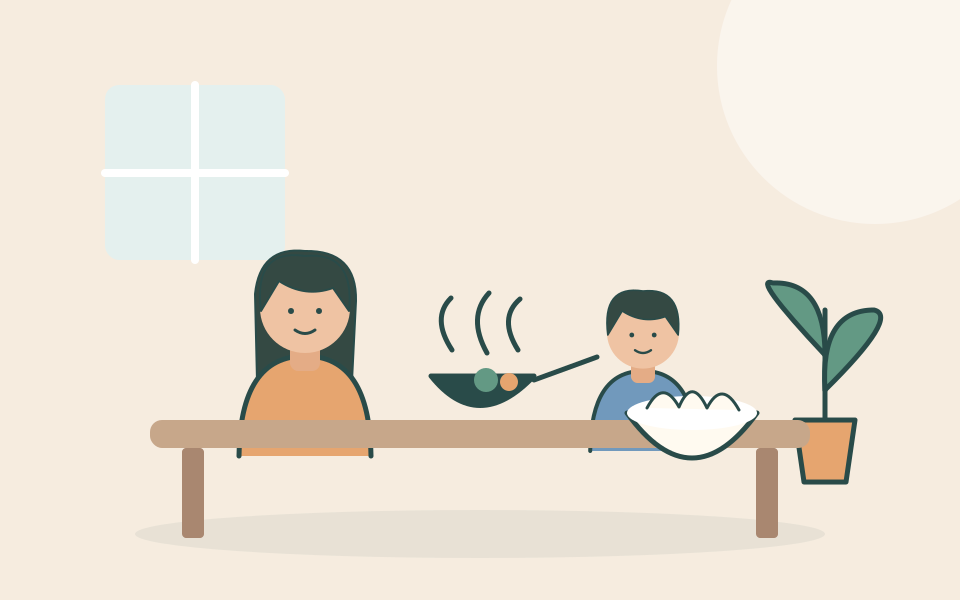
A mother and child cooking Chinese food

A little reading

01

我(Wǒ)。

02

,我(wǒ)。

03

今(Jīn)天(tiān),我(wǒ)和(hé)菜(cài)。

04

:“你(Nǐ)看(kàn)我(wǒ)。”

05

我(Wǒ)看(kàn)了(le),了(le)。

06

爸(Bà)爸(ba)了(le)我(wǒ)的(de)菜(cài),:“很(Hěn)!”

07

我(Wǒ)很(hěn),我(wǒ)了(le)。

Sign in to keep a learning history.
Build your vocabulary

A little vocabulary

huì

can; to know how to

bú huì

cannot; do not know how to (不 + 会)

Zhōngguó cài

Chinese food; Chinese dishes (中国 + 菜)

zuò

to do; to make

xuéxí

to study; to learn

zěnme

how

yě

also; too (extension vocabulary: HSK2)

hǎochī

tasty; delicious (extension vocabulary: HSK2)

shuō

to say; supplemental verb form related to 说话

xǐhuan

to like

Example

我喜欢吃中国菜。
Wǒ xǐhuan chī Zhōngguó cài.
I like eating Chinese food.

chī

to eat

Example

我喜欢吃中国菜。
Wǒ xǐhuan chī Zhōngguó cài.
I like eating Chinese food.

mā ma

mother; mum

Example

妈妈会做中国菜,我不会。
Māma huì zuò Zhōngguó cài, wǒ bú huì.
My mother can cook Chinese food, but I cannot.

zài jiā

at home

Example

今天,我在家和妈妈学习做菜。
Jīntiān, wǒ zài jiā hé māma xuéxí zuò cài.
Today, I learn to cook with my mother at home.

gāoxìng

happy; pleased

Example

我很高兴,现在我会做中国菜了。
Wǒ hěn gāoxìng, xiànzài wǒ huì zuò Zhōngguó cài le.
I am happy. Now I can cook Chinese food.

xiànzài

now

Example

我很高兴,现在我会做中国菜了。
Wǒ hěn gāoxìng, xiànzài wǒ huì zuò Zhōngguó cài le.
I am happy. Now I can cook Chinese food.

Notice the pattern

A little grammar

会(huì) + verb — Knowing how to do something

Subject + 会(huì) / 不会(bú huì) + verb

Use 会(huì) to express a learned skill. 不会(bú huì) means someone does not know how to do it.

Chinese explanation

“会(huì)”表(biǎo)示(shì)通(tōng)过(guò)学(xué)习(xí)掌(zhǎng)握(wò)的(de)技(jì)能(néng),“不(bú)会(huì)”表(biǎo)示(shì)没(méi)有(yǒu)掌(zhǎng)握(wò)。

我(Wǒ)会(huì)做(zuò)菜(cài)。

I can cook.

很(hěn) + adjective — Describing someone or something

Person / thing + 很(hěn) + adjective

A simple adjective predicate often uses 很(hěn) without 是(shì). In context, 很(hěn) can mean very, but it does not always carry strong emphasis.

Chinese explanation

形(xíng)容(róng)词(cí)作(zuò)谓(wèi)语(yǔ)时(shí)常(cháng)用(yòng)“很(hěn)”,一(yì)般(bān)不(bù)加(jiā)“是(shì)”。“很(hěn)”不(bù)一(yí)定(dìng)都(dū)表(biǎo)示(shì)强(qiáng)烈(liè)的(de)“非(fēi)常(cháng)”。

我(Wǒ)很(hěn)高(gāo)兴(xìng)。

I am happy.

Check your understanding

A little practice

Turn both off to practice with Chinese only.

Answers and explanations appear after you submit.

1. 谁教我做菜?

Shéi jiāo wǒ zuò cài?

2. 今天我在哪里学习做菜?

Jīntiān wǒ zài nǎlǐ xuéxí zuò cài?

3. 爸爸觉得我的菜怎么样?

Bàba juéde wǒ de cài zěnmeyàng?

4. 妈妈不会做中国菜。

Māma bú huì zuò Zhōngguó cài.

5. 爸爸吃了我的菜。

Bàba chī le wǒ de cài.

6. 现在我会做中国菜了。

Xiànzài wǒ huì zuò Zhōngguó cài le.